religious education
click or tap the bottom right of film for sound.
Religious Education. It’s more RElevant than you think.
Religious Education affirms the school ethos of ‘Live to Learn, Learn to Live’ in every aspect of the curriculum. Through the study of religion and non-religious worldviews, pupils develop the knowledge, understanding and skills needed to flourish in a diverse and interconnected world. The study of religion is a key element of the humanities: what could be more human than the beliefs, values and convictions that shape people’s identities, inspire acts of compassion and creativity, influence relationships, and, at times, contribute to conflict? RE enables pupils to explore these profound questions with curiosity, respect and critical thinking. In line with the Lancashire Agreed Syllabus for Religious Education, we believe that RE is a core component of a broad and balanced education. It enables pupils to become religiously literate by developing secure knowledge and understanding of Christianity and other principal religions, alongside non-religious worldviews. Pupils are encouraged to investigate, reflect and respond to the beliefs and practices of others while considering their own views, values and experiences. As outlined in the Lancashire Agreed Syllabus, Religious Education helps pupils to understand the role that religion and belief play in individuals’ lives and in society, fostering respect, empathy and mutual understanding. It prepares young people to participate positively in modern Britain and the wider world, equipping them to engage thoughtfully with diversity and to contribute to communities characterised by dignity, dialogue and inclusion. Through meaningful and challenging learning experiences, we aim to inspire pupils to ask important questions, think critically, appreciate different perspectives and develop the confidence to live well alongside others. In doing so, Religious Education truly enables our pupils to live to learn and learn to live.
Overarching questions
-
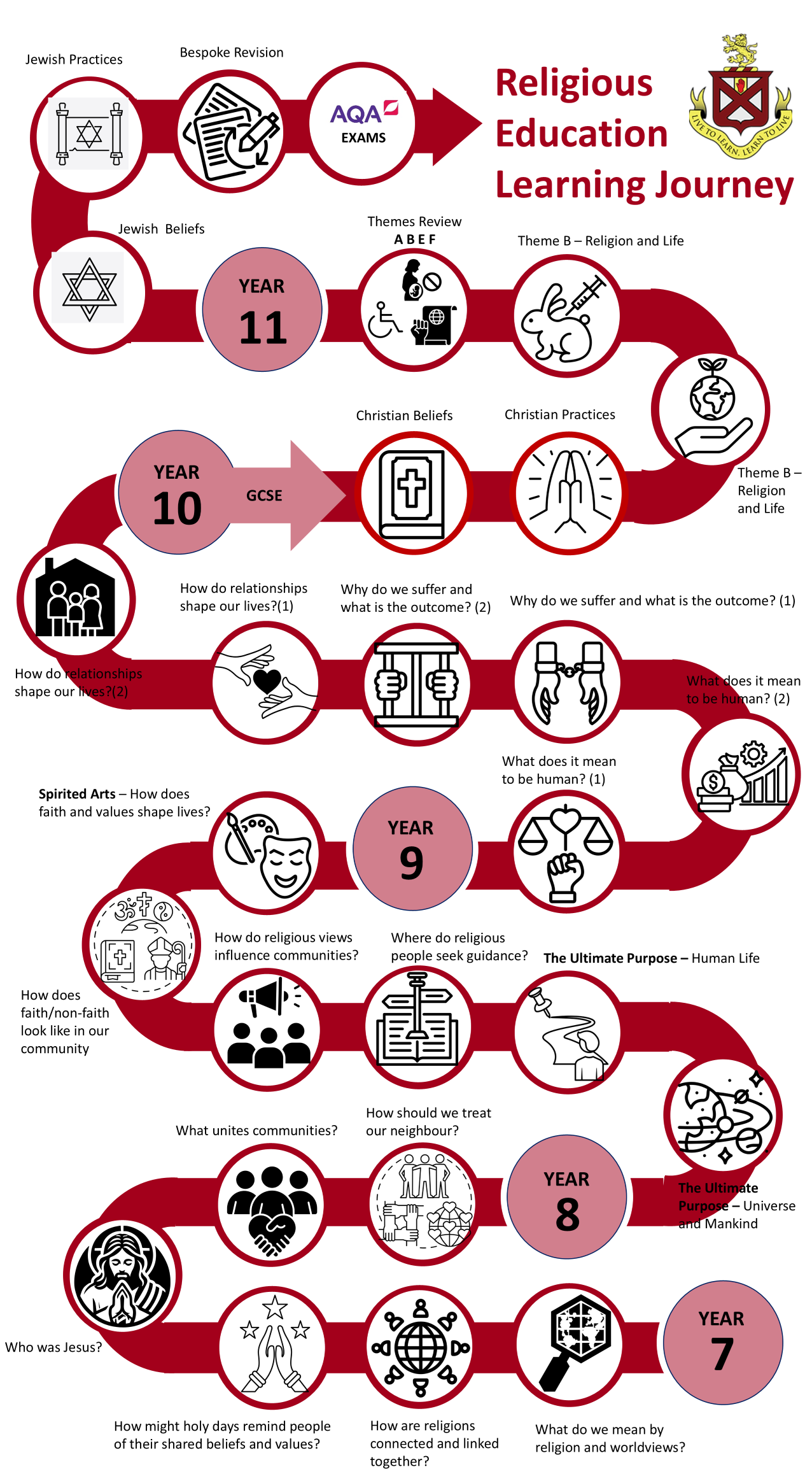
Year 7 – Where do we belong?
- Year 8 – Where can we find guidance?
- Year 9 – What really matters?
- Year 10 and Y11 – GCSE Religious Studies
Click HERE to download the overall learning journey diagram.

| TERM | YEAR 7 | YEAR 8 | YEAR 9 | YEAR 10 | YEAR 11 |
|---|---|---|---|---|---|
| AUTUMN |
|
|
|
|
|
| SPRING |
|
|
|
|
|
| SUMMER |
|
|
|
|
|
Clicking on the buttons below will download a PDF including a further breakdown of topics covered in the subject:
KS3
Regular homework is an integral part of learning. Tasks set will help students to consolidate, develop or broaden their learning. It also helps students to become confident and independent learners, which will help them throughout their time at school and in adult life.
- Students are to be set homework in accordance with the whole school policy requirements.
- Homework is designed to broaden and deepen knowledge acquired during lessons.
- Homework set must be recorded by the teacher on the school’s online homework platform School Synergy.
KS4
-
Homework will be set as appropriate to embed knowledge and practice essential exam skills
- Homework will focus on several key skills in preparation for examination. Deepening learning to improve subject knowledge, improve religious literacy though testing of key terms, GCSE question types and revision homework prior to assessment.